
Product group availability lets you control where every product in a group can be ordered, in Business Hub, on your web stores, or restricted to specific store groups and stores, all from one place instead of setting availability on each product individually. Because the system retains whatever you configure here, these settings become the default that products in the group follow unless a setting is configured directly on an individual product to override it.
Watch the following video to see how to configure product availability at the product group level. Read below for written instructions.
In This Article
- Prerequisites
- Why use this feature?
- Step 1: Open the Availability settings for a product group
- Step 2: Configure Business Hub, Webstore, and Global availability
- Step 3: Configure Store Group and Store-level rules
- Step 4: Save and verify your changes
- Best Practices
- Troubleshooting
- FAQs
- Additional Resources
Prerequisites
- You must have Admin access to use this feature.
- The product group you want to configure must already exist. See Product Groups to create one.
- If you plan to set availability by store group, the store groups you want to use should already be created, with stores assigned to them.
Why use this feature?
Product group availability sets the default availability for every product assigned to that group, in one place, instead of configuring Business Hub, webstore, and store access product by product. Because the system retains this setting with the group, any product left on its Default availability option automatically follows whatever you configure here, and updating the group updates every one of those products at once.
- Manage availability for a whole range of similar products in a single screen instead of product by product
- Restrict specialty, wholesale, or franchise-only product ranges to the right stores without removing them from your overall catalog
- Control whether a group's products can be ordered internally through Business Hub, externally through web stores, or both
- Still allow exceptions, since any availability setting configured directly on a product overrides the group's default
Step 1: Open the Availability settings for a product group
- Log in to your DecoNetwork website.
-
Go to Admin → Products.
The Admin button.
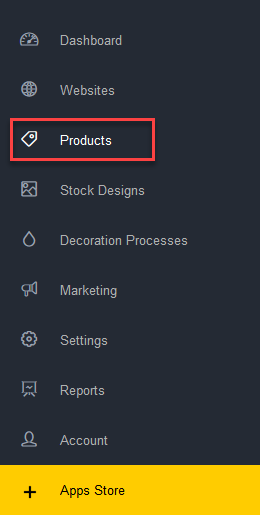
The Products option in the Admin navigation menu.
-
Select Product Groups.
The Product Groups option under the Products menu.
The Product Groups page opens, listing your existing groups.
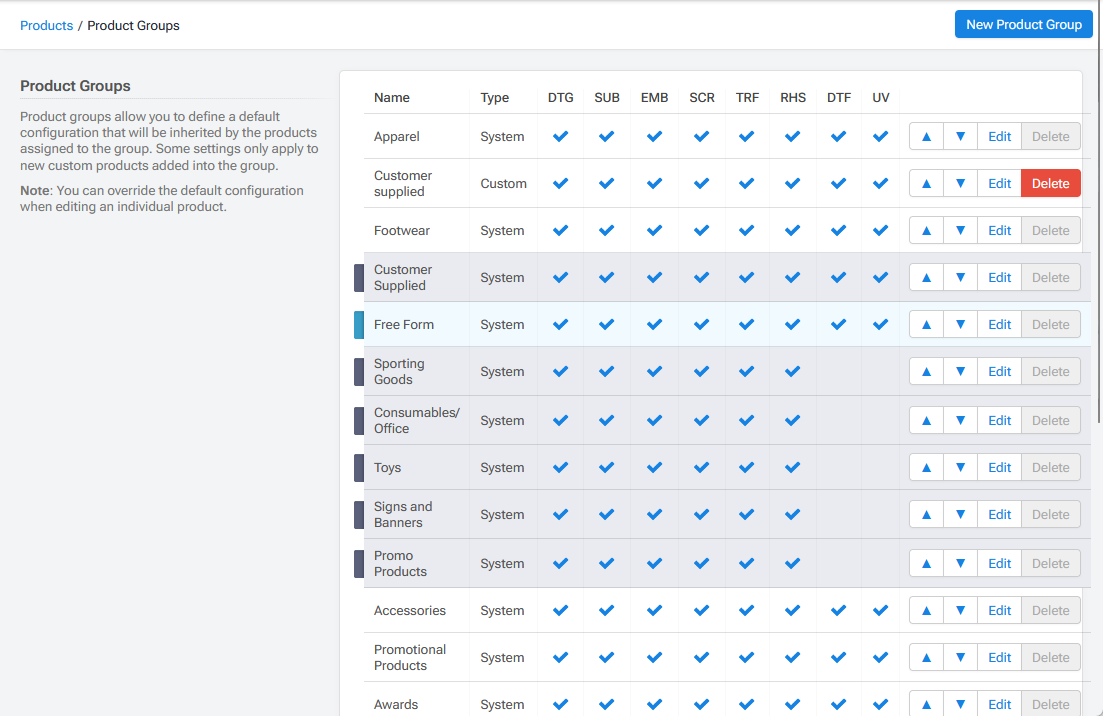
The Product Groups list, showing existing groups.
-
Click Edit beside the product group you want to configure.
The product group's configuration screen opens, with General selected by default.
The product group configuration screen, opened to General settings by default.
-
Select Availability from the menu on the left.
Availability selected in the product group's settings menu.
The main work area shows the availability configuration options for this product group.
Step 2: Configure Business Hub, Webstore, and Global availability
-
Under Business Hub and Webstore Availability, choose whether products in this group can be ordered through Business Hub, through web stores, or both.
Any option that includes web stores makes the group's products available to all web stores.

The Business Hub and Webstore Availability options.
-
Under Global options, set the group's default availability across your stores, in the same fashion as an on/off switch.

The Global availability options.
Choose whether the group's products are available in all stores by default, or in none.
Business Hub, Webstore, and Global availability set the group's baseline behavior. Store Group and Store rules in the next step let you override that baseline for specific parts of your store network. Any product in the group left on the Default availability option follows this baseline automatically.
Step 3: Configure Store Group and Store-level rules
Use Store Group settings to control availability for a whole group of stores at once, and Store rules to control availability for individual stores.
-
To set availability by store group, click Add Rule under Store Group settings.

The Store rules table before any rules are added.
The Select Groups popup opens.

The Select Groups popup, opened from Add Rule under Store Group settings.
-
Enter a group name in the Group name box (wildcards, using *, are supported) and click Search. Select the group you want and click Add Selected Groups.
The group is added to your rule, where you can allow or deny the product group's availability for that store group.

A Store Group rule, with the Allow/Deny setting.
Store groups are created, and their default availability set, under Websites → Store Groups. A store is assigned to a group under Websites → Manage [Store] → Administration → Group Settings (not available for stores owned by the Fulfillment Center).
-
To set availability by individual store, click Add Rule under Store rules.
The Select Stores popup opens.

The Select Stores popup, with search fields and matching stores listed.
-
Search for and select the stores you want, then click Add Selected Stores.
The stores are added to your rule, where you can allow or deny the product group's availability for each store.

A store rule, with the Allow/Deny setting.
Step 4: Save and verify your changes
-
Click Save once you've finished configuring availability for the group.
Your availability settings are saved and retained with the product group, so every product assigned to it immediately follows this availability, unless a product has its own override configured.
Not sure if a group's availability is working as intended for a specific store? Use the Visibility Checker on an individual product's own edit page to test it directly and see the result, instead of checking each setting by hand.
Best Practices
- Configure availability at the product group level first, and reserve individual product overrides for genuine exceptions, so most products can rely on their group's default.
- Organize stores into store groups before setting Store Group rules, so you can manage franchise, wholesale, or regional stores together instead of one at a time.
- Use the Visibility Checker on an affected product after saving to confirm the group's availability behaves as expected for the stores that matter most.
- Review Store Group and Store rules periodically as your store network grows, since new stores don't automatically inherit rules created for existing ones unless they're added to a group.
- Keep group-level availability broad and consistent, and use product-level settings only when a specific product genuinely needs to differ from the rest of its group.
Troubleshooting
Problem: A product in the group isn't showing on a specific web store even though the group's availability looks correct.
Cause: The product has its own Availability override, or a Store Group or Store rule on the group is denying access for that store.
Solution: Open the product's own Availability settings and use the Visibility Checker for that store, then check the group's Store Group and Store rules for a rule that denies access.
Problem: You set a Store Group rule at the group level, but it doesn't seem to apply to one of the stores in that group.
Cause: The store may not actually be assigned to the store group yet.
Solution: Confirm the store is assigned to the group under Websites → Manage [Store] → Administration → Group Settings, then check the group's availability again.
Problem: Changing the group's availability didn't change anything for one of its products.
Cause: That product has an Availability setting configured directly on it, which overrides the group's default.
Solution: Open the product's own Availability page and clear the product-level setting if you want it to follow the group instead.
FAQs
What's the difference between configuring availability at the product group level and at the individual product level?
Availability set at the group level becomes the default that every product in the group follows. A setting configured directly on an individual product always takes priority over the group's default. See Product Availability for the individual product-level walkthrough.
What does the Default option under Business Hub and Webstore Availability or Global options do on an individual product?
It tells that product to follow whatever's configured here at the product group level, instead of using a separate setting on the product itself.
What's the difference between Store Group settings and Store rules?
Store Group settings let you allow or deny the group's products for every store in a group at once. Store rules let you allow or deny them for one specific store. Use whichever level matches how you want to manage the group.
How do I check whether availability is working as expected for a specific store?
Use the Visibility Checker on a product's own edit page. It tests the configured settings, including anything inherited from the product's group, and shows the result directly.
Additional Resources
Still have questions? Use the Search Tool at the top of the page to find more related guides. Need help? Click the icon to submit a support ticket – our Client Services team is ready to assist!
Comments
0 comments
Please sign in to leave a comment.